In the fast-paced world of digital marketing, trends come and go. One year, it’s a specific social media platform; the next, it’s a new type of short-form video. But throughout these shifts, one powerhouse remains constant. If you’ve ever wondered, “What does SEO mean in marketing?” beyond just a buzzword, you’re asking the most important question for your business’s long-term survival.
Search Engine Optimization (SEO) isn’t just a technical task; it is the backbone of sustainable digital growth. Unlike paid advertising, which stops the moment you stop paying, SEO is an investment that compounds over time.
At 1on1 SEO Training, we believe that mastering search isn’t just for “techies” it’s a fundamental skill for any business owner or marketer looking to dominate their niche. If you’re ready to stop renting your traffic and start owning it, our personalized SEO training online can help you bridge the gap between confusion and conversion.
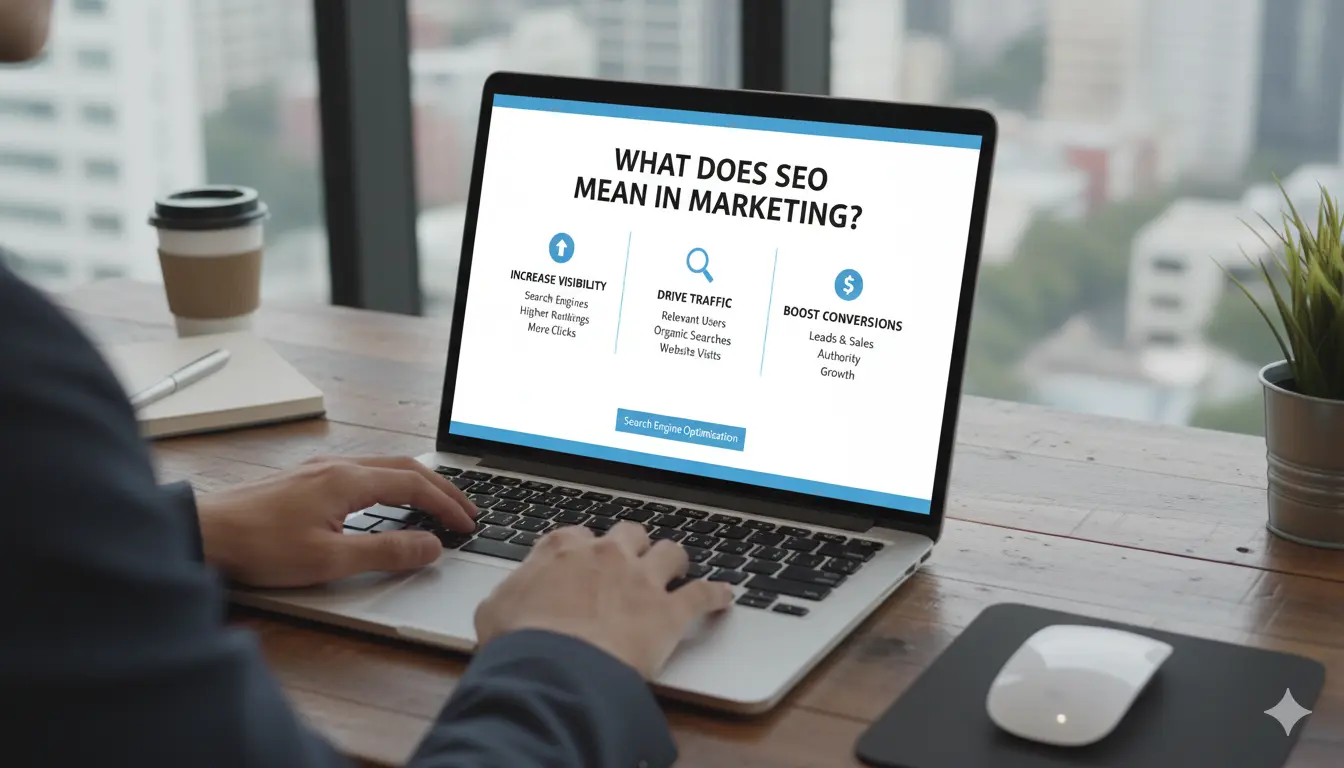
What Does SEO Mean in Marketing? The Modern Definition
To understand why it offers the highest Return on Investment (ROI), we must first answer: what does SEO mean in marketing today?
In its simplest form, SEO is the process of improving your website to increase its visibility when people search for products or services related to your business in Google, Bing, and other search engines. However, in 2026, the definition has evolved. It’s no longer just about ranking #1 for a specific keyword; it’s about becoming the authoritative answer to a user’s problem.
The Three Pillars of Modern SEO
- Technical SEO: Ensuring search engines can crawl and index your site without errors.
- On-Page SEO: Optimizing your content and HTML tags to tell search engines exactly what your page is about.
- Off-Page SEO: Building the reputation and authority of your site through high-quality backlinks and social signals.
When these three work in harmony, your marketing becomes “pull” rather than “push.” Instead of interrupting someone’s day with an ad, you are appearing exactly when they are looking for a solution.
Why SEO Delivers the Highest ROI
Marketing budgets are finite. When deciding where to allocate your dollars, ROI is the only metric that truly matters. Here is why SEO consistently outperforms PPC, social media marketing, and email in the long run.
1. Cost-Effectiveness Over Time
With Paid Search (PPC), your Cost Per Lead (CPL) remains relatively static or increases as competition grows. With SEO, your upfront costs (content creation and optimization) may be higher, but your ongoing cost per click is $0. Over 12–24 months, the “equity” you build in your domain results in a much lower acquisition cost than any paid channel.
2. Trust and Credibility
Users have developed “ad blindness.” We instinctively skip the “Sponsored” results to find the organic listings. Ranking organically signals to the user that Google trusts your content enough to recommend it without being paid. That psychological “seal of approval” leads to higher conversion rates.
3. Presence in AI Overviews and Citations
The rise of AI-driven search means that being an authority is more important than ever. When AI agents (like Gemini or Perplexity) answer a user’s question, they cite their sources. A well-optimized SEO strategy ensures your brand is the one being cited as the expert source, putting you in front of users before they even click a link.
How to Master SEO: A Roadmap to Success
Understanding the “what” is easy; mastering the “how” is where most people get stuck. The landscape changes rapidly, and what worked in 2023 could penalize you in 2026.
Step 1: Keyword Research Focused on Intent
Don’t just chase high volume. Focus on User Intent. Are they looking for information (Informational), comparing products (Commercial), or ready to buy (Transactional)? Mastering SEO means aligning your content perfectly with what the user expects to find.
Step 2: Quality Content is the New King
Search engines now prioritize “Experience, Expertise, Authoritativeness, and Trustworthiness” (E-E-A-T). To rank, your content must provide genuine value. Avoid “AI-fluff”—write for humans first, search engines second.
Step 3: Technical Health
If your site takes 5 seconds to load, your SEO will suffer regardless of how good your content is. Focus on Core Web Vitals, mobile-friendliness, and a secure (HTTPS) connection.
Step 4: Continuous Learning
This is the most critical step. Because algorithms update daily, the best way to master the craft is through structured SEO training online. Learning from a mentor who sees the data across multiple industries can save you months of “trial and error.”
The Advantage of 1-on-1 SEO Training Online
The internet is flooded with “SEO courses,” but most are pre-recorded videos that are outdated by the time you finish the first module.
SEO is not a one-size-fits-all discipline. A local plumber needs a different strategy than a global SaaS company. This is why 1-on-1 SEO Training is the most effective way to learn. You get to work on your website, targeting your competitors, with a mentor who can answer your specific questions in real-time.
FAQ: Common Questions About SEO in Marketing
What is the difference between SEO and SEM?
SEO (Search Engine Optimization) focuses on earning organic traffic through rankings. SEM (Search Engine Marketing) is a broader term that includes both SEO and paid search (PPC).
How long does it take to see ROI from SEO?
Generally, you will start to see significant movement in 3 to 6 months. However, for highly competitive niches, it can take 6 to 12 months to see a full return on your investment. Remember, SEO is a marathon, not a sprint.
Can I do SEO myself, or do I need a pro?
You can certainly learn the basics yourself! However, because the stakes are high and mistakes can lead to “de-indexing” (being removed from search results), many choose to fast-track their results with professional SEO training online.
Does SEO still work with AI search engines?
Yes! In fact, SEO is more important now. AI models rely on indexed web content to provide answers. If your site is not optimized for search engines, it won’t be “seen” by AI models either.
Conclusion: Take Control of Your Digital Future
In the modern marketing mix, SEO is the only channel that builds long-term brand equity. When you understand what does SEO mean in marketing and how to apply it, you stop chasing the algorithm and start leading your industry.
Don’t let your competitors capture the traffic that belongs to you. Whether you are a business owner looking to scale or a marketer wanting to upgrade your skill set, the most direct path to mastery is through personalized guidance.
Ready to dominate the SERPs? Book your personalized 1on1 SEO Training today and start building your highest-ROI marketing pillar.